

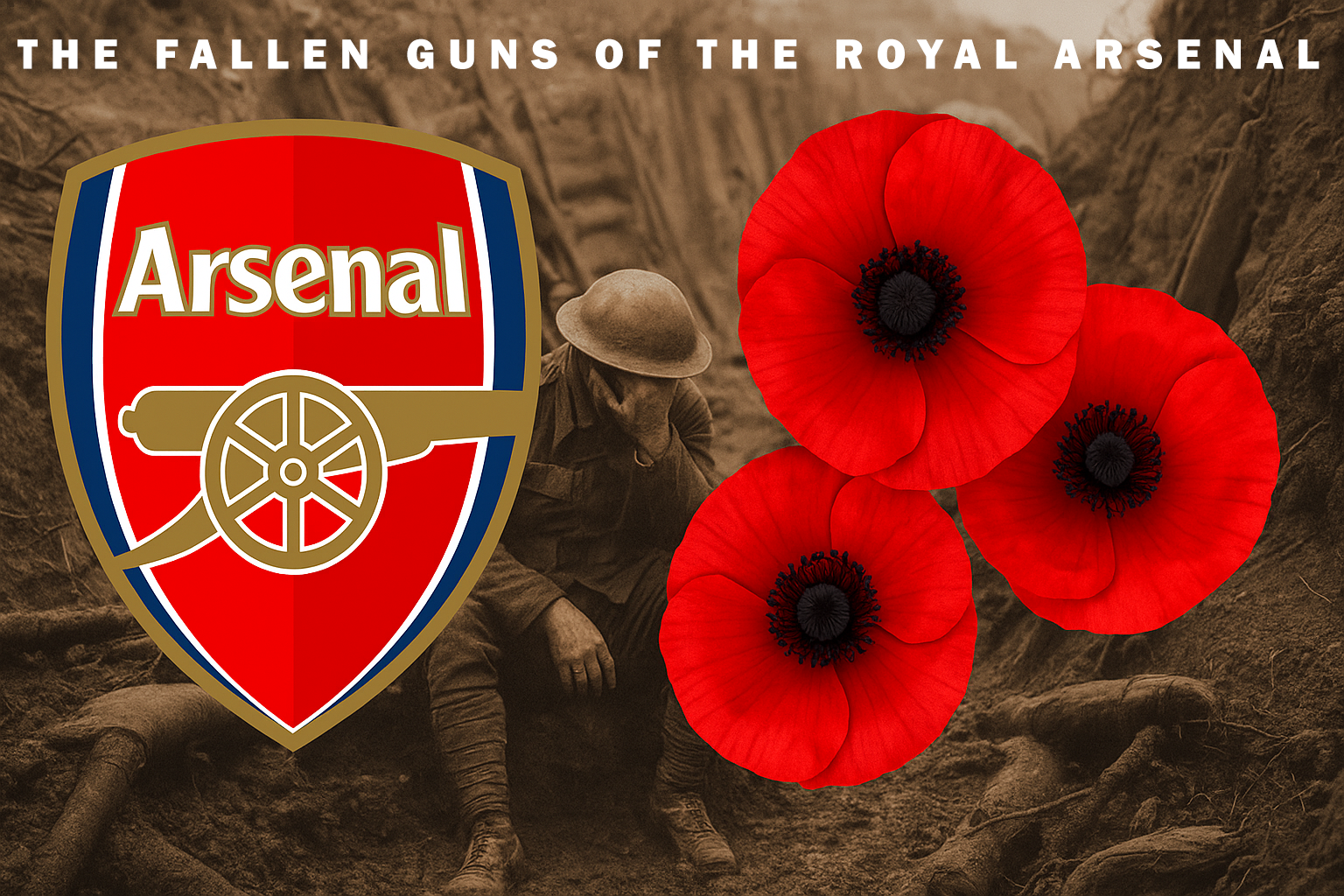
🕊️ The Fallen Guns of The Royal Arsenal
By Ayse (@Lambethwalk2211)
Published on In The North Bank Blog
The story of Arsenal First World War players is one of courage, loss, and remembrance. In this piece, I explore the connection between the Gunners’ military roots and the sacrifices made by players who fought in the Great War.
⚽ From Classroom to the Battlefield
It’s a cold day in November and I’m teaching my Year 9s about the First World War. I show them two pictures: one of a soldier sat in the mud with his head in his hands — exhausted, broken, surrounded by the devastation of war — and another of the inside of the Emirates Stadium, home of my beloved Arsenal Football Club.
At first, my students are confused. What’s the connection?
Their answers range from the obvious — “they’ve got guns on their badge,” “Arsenal means weapons” — to the wonderfully imaginative. Yet none ever land on the truth.
So, what is the answer I’m looking for?
On the first day of the Battle of the Somme, July 1st, 1916, 57,470 British soldiers were wounded or killed, including 19,240 fatalities. The closest modern comparison to visualize that number? The Emirates Stadium, with its capacity of around 60,000. When my students realize that every seat in that stadium could represent a soldier killed or injured in a single day, silence fills the room.
⚙️ When Football Spoke the Language of War
The overlap between football and warfare runs deeper than most realize. Supporters call the pitch No Man’s Land — even referenced in All Together Now by The Farm. England vs. Germany matches are inevitably described as “old rivalries,” echoing both sporting and historical conflicts.
And of course, there’s the legendary Christmas Truce, when German and British soldiers put down their guns for a spontaneous match of football on the Western Front.
For me, that connection between the battlefield and the pitch goes beyond metaphor — it links my two great passions: history and Arsenal Football Club.
❤️ My Arsenal Story
My first Arsenal match was Ray Kennedy’s testimonial at Highbury, April 27th 1991. I was just nine. My dad had long wanted to take me, but after Hillsborough, Mum understandably hesitated. Dad used to describe the North Bank packed beyond capacity, fans standing shoulder-to-shoulder on the cold concrete.
That first match sparked something in me. By 25, I was a season ticket holder — a history teacher by profession, an Arsenal fan by blood, and increasingly fascinated by the club’s deep wartime roots.
🏭 From Dial Square to The Royal Arsenal
Arsenal’s origins are rooted in the military. Founded in 1886 as Dial Square by munitions workers at the Royal Arsenal in Woolwich, the club soon became The Royal Arsenal — a name drawn from the nearby armaments factory.
When The Great War began in 1914, Arsenal had just settled into their new home at Highbury (to the annoyance of Tottenham). The Football League initially continued for morale, but by 1915 most players and staff had joined the war effort.
Rivalries were put aside; Arsenal and Spurs players fought together in the Middlesex Regiment’s Footballers’ Battalion — among them, Second Lieutenant Walter Tull, the first Black British officer to serve in combat and a former Spurs player (Read more here.).
🔍 Tracing the Fallen Gunners
In summer 2024, my husband and I travelled through the battlefields of France and Belgium to trace Arsenal’s wartime heroes — men who had once worn the red and white but never came home.
Arsenal officially lists eight players who died in service:
Spencer Bassett, Albert Beney, John Flanagan, James Maxwell, Charles Randall, Robert Houston, Joseph Dines, and Dick Roose.
I focused my research on six of them — visiting their memorials and graves, uncovering their stories, and paying my respects on behalf of all Gooners.
⚰️ Lance Corporal Robert Houston
-
Regiment: 17th Battalion (1st Football), Middlesex Regiment
-
Killed in action: 13 November 1916
-
Commemorated: Thiepval Memorial
A Scotsman from Lanark, Houston left his wife Mary behind in Carlisle when he signed for Arsenal. He was killed during the Somme and has no known grave. His story, like so many others, is a haunting reminder of sacrifice.
🧤 Leigh Richmond Roose
-
Regiment: Royal Fusiliers, City of London Regiment
-
Killed: 7 October 1916
-
Commemorated: Thiepval Memorial
A goalkeeper of legend, Roose played for nine clubs — including Arsenal, Fulham, Everton, Aston Villa, and Celtic — and was known for his fearless brilliance. When he vanished in battle near Gueudecourt, 200 comrades disappeared with him. Sunderland still honours him each Remembrance Day.
🪖 Corporal Thomas Farrell
-
Regiment: Lancashire Fusiliers
-
Killed: 1 July 1916 (Battle of the Somme)
-
Buried: Auchonvilliers Military Cemetery
A former Arsenal and Manchester City player, Farrell fought at Gallipoli before moving to France. He died during the opening assault at Beaumont Hamel, leaving behind his wife Frances and three children.
💣 Gunner Spencer Bassett
-
Regiment: Royal Garrison Artillery
-
Killed: 11 April 1917
-
Buried: Pozieres British Cemetery
Born in Blackheath in 1885, Bassett embodied the modern athlete’s discipline long before it was fashionable. He died of wounds sustained during the advance on the Hindenburg Line.
⚰️ Private Charles Edward Randall
-
Regiment: 4th Pioneer, Coldstream Guards
-
Killed: 27 September 1916
-
Buried: Dantzig Alley British Cemetery
Randall joined Arsenal from Newcastle in 1911, scoring 12 goals in 45 appearances. His wife Mary Elizabeth lost both a child and her husband within a short time — one of thousands of families shattered by war.
⚙️ Corporal Albert (Bert) Beney
-
Regiment: Royal Engineers
-
Died of wounds: 20 April 1915
-
Buried: Poperinghe Old Military Cemetery (Ypres)
Born in Hastings, Beney moved from Arsenal to Bury before enlisting. When I found his grave, I saw a small wooden cross left by another Arsenal supporter — proof that more than a century on, the Gunners still remember their own.
❤️ Lest We Forget
Visiting those graves — seeing those names carved in stone — reminded me that football is more than a game. It’s a living connection between past and present, between the roar of the crowd and the silence of remembrance.
These men were Gunners — on the pitch and on the front line.
Their stories deserve to be told.
They are, and always will be, The Fallen Guns of The Royal Arsenal.
Written by Ayse (@Lambethwalk2211)
For In The North Bank
#Arsenal #WWI #RoyalArsenal #Remembrance #COYG